People Don’t Search for Legal Services. They Search for What Happened to Them.
Lawggle
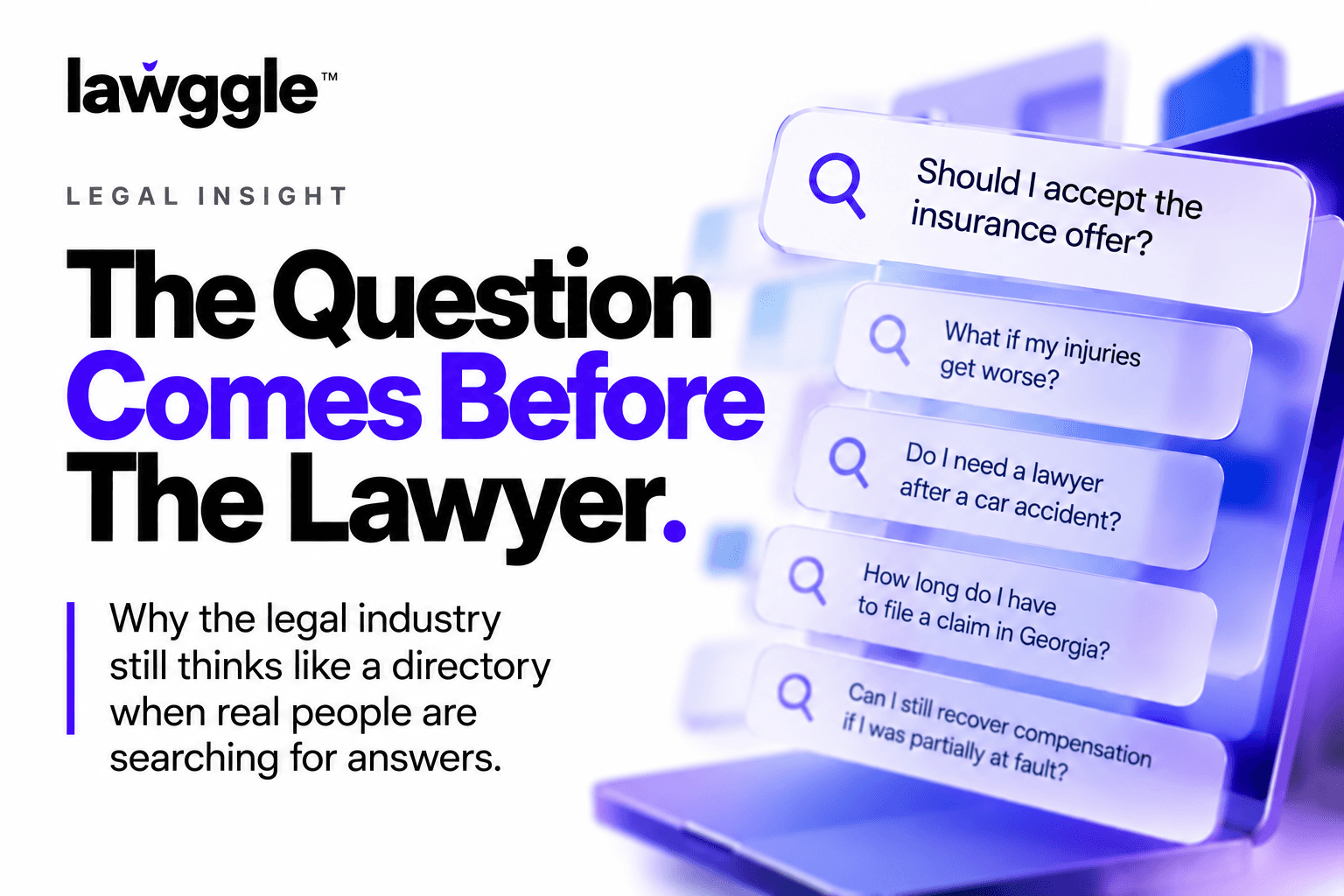
People Don’t Search for Legal Services. They Search for What Happened to Them.
The way people look for legal help is changing. But the way we organize legal services hasn't quite caught up.
Imagine you've just been in a car accident.
You're sitting at home a few days later. Your neck still hurts. The insurance company has called twice, and now there's a settlement offer sitting in your inbox.
You don't know whether it's fair. You don't know whether your injuries will get worse. And you certainly don't know whether accepting the offer means giving up rights you didn't realize you had.
So you pick up your phone.
What do you search?
Probably not “personal injury attorney specializing in motor vehicle negligence litigation.”
More likely:
“Should I accept the insurance company's settlement offer?”
That's where the search for legal help begins.
Not with a lawyer's name. Not necessarily with a practice area.
With a problem.
The Legal Industry Has Organized Itself Around Lawyers
For decades, finding a lawyer has largely meant navigating directories, practice areas, locations and professional profiles.
Personal Injury. Family Law. Criminal Defense. Employment Law.
These categories make perfect sense to lawyers. They're how law firms organize their services, how directories classify professionals and how much of the legal industry describes itself.
But they're not necessarily how people experience legal problems.
Someone whose employer has just fired them may not know whether they have an employment law issue.
Someone whose former partner is refusing to let them see their children may not know what a parenting order is.
Someone who receives a letter threatening legal action may not know whether they need a litigation lawyer, a business lawyer or no lawyer at all.
They know what happened, and they want to know what to do next.
That's a meaningful difference.
The Question Comes Before the Lawyer
Consider these searches:
“My husband emptied our joint bank account before filing for divorce. What can I do?”
“The police want me to come in for questioning. Should I go?”
“My employer offered me severance. How do I know if it's enough?”
Each question represents someone trying to make sense of a situation that could have serious consequences.
They're not necessarily comparing lawyers yet.
They're trying to understand whether they have a legal problem, what their options might be and whether professional help is necessary.
This is what we call the before-the-lawyer moment.
It's the space between experiencing a problem and deciding to contact a lawyer.
And it's an important part of legal discovery that deserves more attention.
A Lawyer's Most Valuable Introduction Might Be an Answer
Think about how people traditionally evaluate a lawyer they've never met.
They might read a biography, look at years of experience, review practice areas or browse testimonials.
All of those can be useful, but imagine being able to hear that lawyer explain the very issue keeping you awake at night.
You can hear how they communicate. You can see whether they understand the situation. You can get a sense of the questions you might want to ask during a consultation.
You haven't hired anyone. You haven't even made a phone call, but you've learned something about the person who might eventually help you.
That's a different kind of introduction.
It doesn't replace professional credentials, independent research or a proper consultation. It gives people another meaningful way to evaluate whether a lawyer might be right for them. And it allows lawyers to demonstrate what they know rather than relying entirely on what their profiles say about them.
One Legal Problem Rarely Produces Just One Question
Let's return to that car accident.
The first question might be whether to report the accident.
Then the insurance company requests a recorded statement.
A few days later, symptoms appear that weren't noticeable immediately.
Then comes the settlement offer.
Each development creates another question.
Traditionally, someone might search for each answer separately, moving between websites, articles and directories without ever finding a clear connection between the information and the professionals who provide it.
But these aren't unrelated searches. They're different stages of the same experience.
What if legal information were organized around that experience?
Someone dealing with a car accident could explore relevant questions about insurance, injuries, compensation and legal representation. And alongside those answers, they could discover verified lawyers who have addressed those specific concerns.
Not because a lawyer paid to appear beside a particular keyword, but because that lawyer has contributed a relevant answer.
That is a more useful connection between legal knowledge and legal discovery.
Search Is Becoming More Conversational
People have always searched using questions.
But conversational search tools make it increasingly natural to describe an entire situation instead of typing a few keywords.
Someone might ask:
“I was rear-ended in Atlanta, the other driver's insurance company offered me money, but my back still hurts. Should I accept it?”
That single question contains a location, an accident, an insurance dispute, an injury and an important decision.
It's much richer than “Atlanta personal injury lawyer.”
And it illustrates why legal content needs to do more than repeat practice-area keywords.
It needs to address real situations clearly, accurately and in language people understand.
Search engines and AI systems may surface that information in different ways, but the underlying opportunity is the same: make useful legal knowledge accessible when someone needs it.
For lawyers, that means the questions they answer every day can have value beyond the original conversation.
An explanation given once may help another person recognize a similar issue months later.
What We've Built at Lawggle
At Lawggle, we believe legal discovery should begin with the person who needs help.
That's why our platform connects real legal questions with answers from verified lawyers.
Lawyers contribute their knowledge through video and written answers. Those explanations become searchable content that people can explore before deciding whom to contact.
We're also working toward making those answers easier to discover together, organized around the problems people experience rather than treating every question as an isolated piece of information.
Because someone dealing with a divorce shouldn't have to understand the structure of family law to find useful answers.
Someone facing criminal charges shouldn't need to know the correct legal terminology before finding a criminal defense lawyer.
And someone injured in an accident shouldn't have to navigate dozens of unrelated profiles before discovering a lawyer who has addressed their concerns.
The legal problem should lead the way.
The Future of Legal Discovery Starts With Understanding
Lawyers know far more than the internet knows about them.
Every day, they explain complicated situations, answer difficult questions and help people understand their options.
Much of that knowledge remains inside consultations, phone calls and private conversations. Meanwhile, people searching online are often looking for answers to those very same questions.
Connecting those two realities is an opportunity to make legal discovery more useful for everyone.
People get access to relevant information from real legal professionals, and lawyers have more opportunities to be discovered for what they know.
And the process of finding legal help can begin somewhere more natural than a directory category.
Because people don't start with the law.
They start with what happened to them.
Lawggle connects real legal questions with answers from verified lawyers. Explore legal questions, learn from practicing attorneys and find a lawyer who may be able to help.
For general information only. Not legal advice. No attorney-client relationship is created.