Can My Employer Read Text Messages on My Personal Phone?
Lawggle
support@lawggle.com
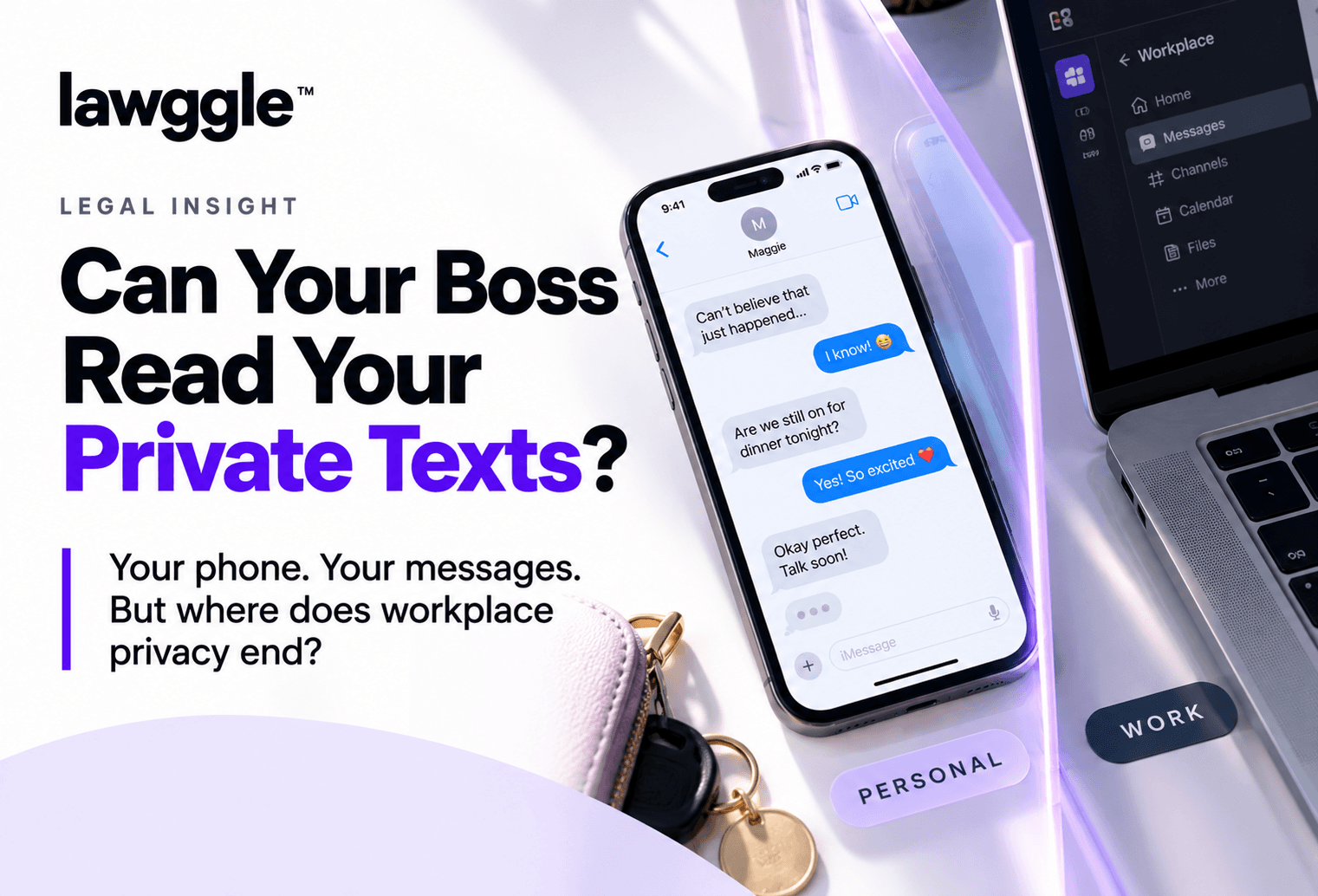
Can My Employer Read Text Messages on my Personal Phone?
Your phone is yours, and your text messages feel private. So your employer can't read them... right?
Usually, it's not quite that simple.
Whether an employer can access, monitor, or use messages from your personal phone can depend on where you live, who owns the device, which accounts you used, what workplace policies you agreed to, and how your employer obtained the messages.
And there is an important distinction:
Can your employer access your private messages?
And:
Can your employer use private messages that someone else gives them?
Those are not always the same legal question.
Can My Employer Read Messages on My Personal Phone?
If you own the phone and you're using a personal account, you will generally have a greater expectation of privacy than you would on a company-owned device.
But using a personal phone doesn't automatically make everything on it untouchable by your employer.
The situation can become more complicated if you:
- connected your phone to company systems;
- installed employer-required software;
- enrolled your phone in a workplace device-
management program;
- used a company email or messaging account;
- agreed to a bring-your-own-device (BYOD) policy;
- used workplace networks or systems; or
- regularly used your personal phone for work.
The details matter.
What If My Text Messages Were Completely Private?
Imagine you send a text from your personal phone using your personal account.
Your employer doesn't necessarily have the right to simply take your phone, open it, and start reading your private conversations.
But that isn't the only way an employer might see those messages.
Someone else could show them.
A coworker could take a screenshot.
The person receiving the messages could forward them.
The messages could be provided during a workplace complaint or investigation.
That means the legal issue may not be whether your employer was allowed to access your phone at all.
The issue may instead become whether your employer can use messages it received from someone else.
Can My Employer Use Screenshots of My Private Messages?
Potentially.
A screenshot can move what felt like a completely private conversation into the workplace very quickly.
This can become particularly important when messages involve things like:
- harassment;
- threats;
- discrimination;
- coworkers;
- customers or clients;
- confidential company information;
- workplace misconduct; or
- comments about management.
The fact that a message was sent from a personal phone does not necessarily mean an employer has to ignore it if the message is later brought to its attention.
Whether the employer can act on it, and what action it can legally take, depends on the circumstances and the law where you live.
What If I Was Texting a Coworker Outside of Work?
This is where the line between "personal" and "workplace" can become blurry.
Two employees might be texting each other at night, from their own homes, using their own phones.
That sounds completely private.
But what happens if one employee later complains that the messages were threatening or harassing?
What if confidential workplace information was shared?
What if the conversation becomes evidence in a workplace investigation?
Conduct doesn't necessarily become irrelevant to an employer simply because it happened outside the office or outside working hours.
At the same time, an employer's ability to discipline or terminate an employee over off-duty conduct can vary significantly depending on the jurisdiction and circumstances.
Can My Employer Read My WhatsApp, iMessage, Signal, or Other Messages?
The messaging app itself isn't necessarily the deciding factor.
What often matters more is:
- who owns the device;
- who controls the account;
- whether workplace systems were involved;
- whether the employer installed software on the device;
- what workplace policies apply;
- how the employer obtained the messages; and
- the privacy and employment laws where you live.
A personal WhatsApp conversation on your own phone can present very different legal issues from a conversation occurring through an employer-controlled account or device.
Can My Employer Monitor My Personal Phone?
An employer may have legitimate reasons to monitor company systems and company-owned devices.
A personally owned phone can be different.
However, if employees use personal devices for work, employers sometimes require security software, mobile-device management, or BYOD agreements.
Before installing employer-controlled software on a personal device, employees should understand what the software can access and what workplace policies actually permit.
Can My Employer Search My Personal Phone?
If your employer asks to see your personal phone during a workplace investigation, don't automatically assume that you either:
have to hand it over, or can safely refuse.
Your rights and obligations can depend on your jurisdiction, employment relationship, workplace policies, the nature of the investigation, and what information the employer is seeking.
Before giving an employer broad access to a personal device containing private photos, conversations, emails, banking information, health information, or other personal data, consider getting legal advice about what the employer is actually entitled to request.
Can I Be Fired for a Private Text Message?
Potentially.
But that doesn't mean every termination over a private message is lawful.
There can be a significant difference between an employer having a reason to discipline someone and having sufficient legal grounds to terminate that employee without notice, severance, or other compensation.
Questions can include:
- What did the message say?
- Who received it?
- Was another employee involved?
- Did it affect the workplace?
- Was confidential information disclosed?
- Was the message threatening or discriminatory?
- How did the employer obtain it?
- What workplace policies applied?
- Was the employee terminated for cause?
- What does the law say in that jurisdiction?
A message being "private" doesn't automatically prevent an employer from acting on it.
But an employer seeing a private message doesn't automatically give the employer unlimited rights either.
What If I Used My Personal Phone for Work?
This is increasingly common.
Employees use their personal phones to check email, message coworkers, access Slack or Microsoft Teams, take work calls, open documents, and log into company systems.
That convenience can blur the boundary between personal and workplace information.
If you're using your personal phone for work, it's worth understanding your employer's BYOD, privacy, monitoring, cybersecurity, and device-management policies before a problem occurs.
Does My Employer Have to Tell Me They're Monitoring Me?
The answer depends heavily on where you live and what is being monitored.
Privacy and workplace-monitoring laws vary between countries, states, and provinces.
Some jurisdictions impose specific requirements regarding electronic monitoring, privacy, notice, or the collection and use of employee information.
That's why generic internet advice about workplace privacy can be misleading.
Your location matters.
What Should I Do If My Employer Accessed My Private Messages?
Don't immediately delete messages or other information that could become relevant.
Instead, consider documenting:
- what happened;
- when you discovered it;
- what device was involved;
- whether the device belongs to you or your employer;
- which account or app was involved;
- whether you installed employer software;
- what workplace policies you agreed to;
- how you believe your employer obtained the messages;
and
- what your employer did after seeing them.
If you've been disciplined, suspended, investigated, or terminated because of private messages, consider speaking with an employment lawyer in your jurisdiction before making major decisions or signing anything.
The Bigger Issue: Where Does Work End and Privacy Begin?
Phones have blurred a line that used to be much easier to see.
Work happens on personal phones.
Personal conversations happen between coworkers.
Work accounts sit beside private accounts.
And screenshots can move a conversation from one person's phone into a workplace investigation in seconds.
That's why the answer to:
"Can my employer read my texts?"
is often:
It depends on whose device it is, whose account it is, what you agreed to, how the messages were obtained, what the employer did with them, and where you live.
Questions People Also Ask About Workplace Privacy
Can my boss read my private text messages?
It depends on the device, account, workplace policies, how the messages were obtained, and the law in your jurisdiction. Messages on a personally owned device may raise different privacy issues than messages on a company-owned phone.
Can my employer read messages on my personal phone?
An employer does not necessarily have unrestricted access to a personally owned phone simply because you are an employee. However, the situation may be different if you use employer-controlled accounts, software, networks, or device-management systems.
Can my employer use screenshots of my private messages?
Potentially. Even if an employer didn't access your phone directly, another person may provide screenshots or copies of messages. Whether and how an employer can act on those messages depends on the circumstances.
Can my employer read my WhatsApp messages?
Using WhatsApp doesn't automatically determine whether a message is legally private. Device ownership, account control, workplace policies, how the messages were obtained, and local law can all matter.
Can I be fired for private text messages?
Potentially, but whether the termination is lawful depends on what happened, the connection to the workplace, the applicable employment laws, and other circumstances.
Can my employer search my personal phone during an investigation?
Don't assume you must automatically provide unrestricted access to your personal device. Your rights and obligations depend on the circumstances and jurisdiction. Consider getting legal advice before providing broad access to personal information.
Can my employer monitor Slack or Microsoft Teams?
Employers may have significantly greater ability to access or monitor communications occurring through employer-controlled workplace systems than communications through purely personal accounts and devices.
Does my employer have to tell me if they're monitoring me?
That depends on the applicable privacy and employment laws. Electronic-monitoring requirements vary by jurisdiction.
Have a Workplace Privacy Problem?
If your employer accessed private messages, asked to search your phone, disciplined you because of a private conversation, or terminated you over messages you believed were personal, the details matter.
Ask your legal question, explore answers from verified lawyers, or Find an Employment Lawyer on Lawggle.
Real Questions. Real Answers. Real Lawyers.
DISCLAIMER: This article provides general legal information only and is not legal advice. Employment, privacy, electronic-monitoring, and workplace laws vary by jurisdiction and circumstances. Speak with a qualified lawyer in your jurisdiction about your specific situation.