California Startup Legal Checklist for Founders and Creators
Lawggle
support@lawggle.com
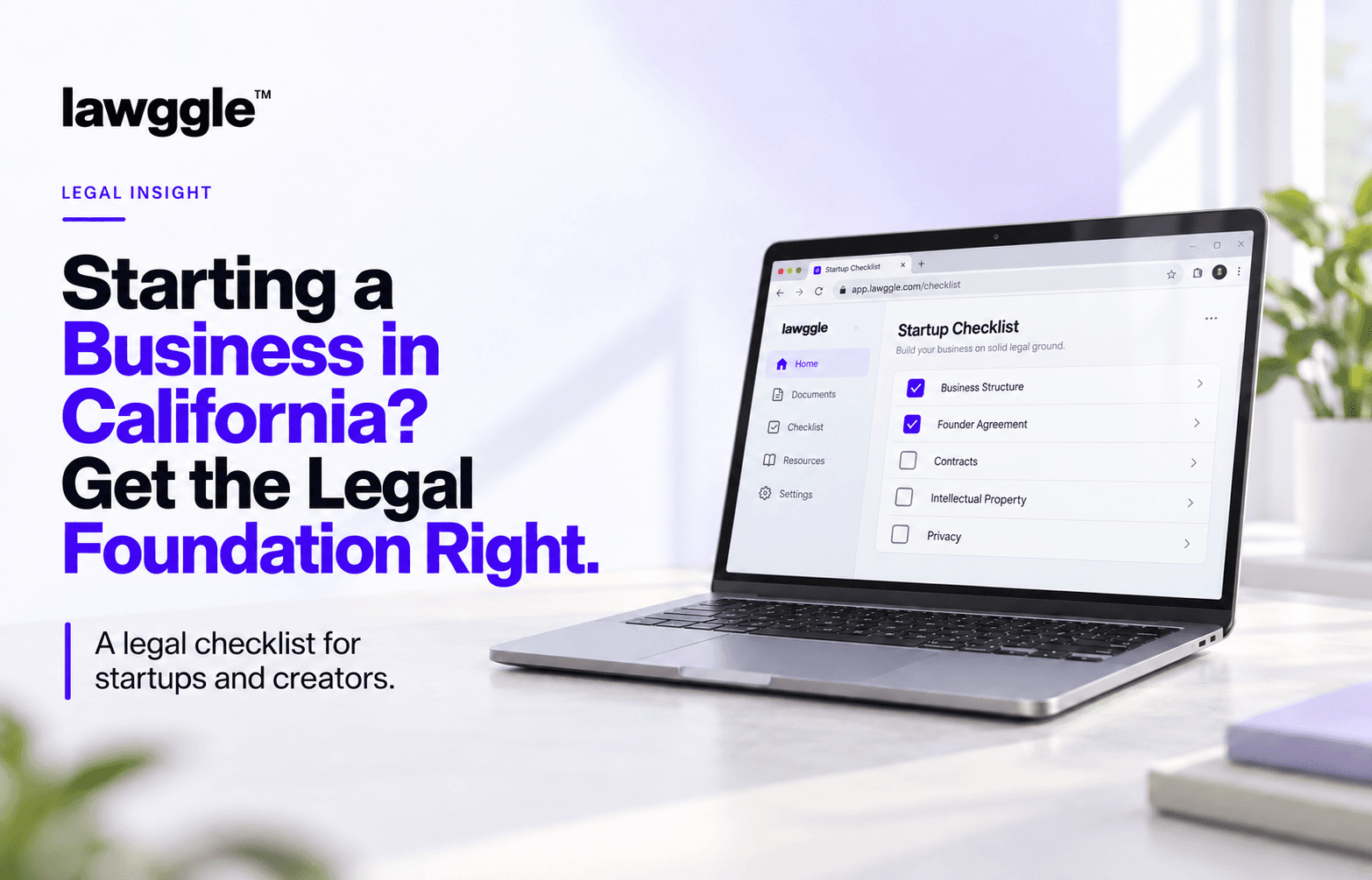
California Startup Legal Checklist for Founders and Creators
Starting a business often begins informally. Two people have an idea. A creator hires a developer. Friends agree to become co-founders. Someone buys a domain, opens a social-media account and starts accepting payments.
Then the business grows.
Suddenly, nobody is entirely sure who owns the company, who owns the work, how profits are divided or what happens if someone leaves.
Many startup disputes do not begin because someone intended to do something wrong. They begin because important decisions were never documented.
This California startup legal checklist explains the issues founders and creators should consider early, before uncertainty becomes conflict.
Lawggle features legal answers from real lawyers, including Bahar Ansari, a business lawyer based in Irvine, California, USA, who works with startups, creators and growing companies.
What is the biggest legal mistake California startups and creators make?
One of the most common mistakes is relying on assumptions instead of written agreements.
Founders may believe they have agreed on ownership, responsibilities and compensation without ever discussing the details. A creator may assume that paying a designer or developer means the business automatically owns everything produced. A company may begin using a name without investigating whether another business already has trademark rights.
These problems can remain invisible while everyone is getting along. They usually surface when the business starts earning money, raises investment, attracts a buyer or experiences a disagreement.
Should I form an LLC or corporation in California?
The right business structure depends on the company’s owners, activities, tax position, growth plans and potential liabilities.
Common options include:
- Sole proprietorship
- Partnership
- Limited liability company
- Corporation
Forming an LLC or corporation may help separate certain business obligations from an owner’s personal affairs, but creating the entity is only the beginning. The business must also maintain appropriate records, complete required filings, pay applicable taxes and operate consistently with its governing documents.
California businesses may have filing and tax obligations with both the California Secretary of State and the Franchise Tax Board. For example, California LLCs are generally subject to an $800 annual tax and may have additional filing obligations or fees.
The fact that an entity has been registered does not mean every other legal issue has been addressed.
Is forming an LLC enough to protect my business?
No. An LLC is a type of business entity. It is not a substitute for contracts, insurance, intellectual-property protection or legal compliance.
An LLC does not automatically:
- Give the business ownership of work created by contractors
- Register or protect the company’s trademark
- Prevent disputes between founders
- Make every contract enforceable
- Protect an owner who personally guarantees a debt
- Eliminate employment, tax or regulatory obligations
- Protect someone from responsibility for their own wrongful conduct
Entity formation is one part of a larger legal foundation.
Do California startups need a founders’ agreement?
If two or more people are building a business together, their agreement should be documented as early as possible.
A founders’ agreement or the company’s governing documents should address questions such as:
- Who owns what percentage of the company?
- What is each founder contributing?
- What responsibilities does each person have?
- Will founders receive salaries?
- How will major decisions be made?
- What happens if the founders disagree?
- Can a founder sell or transfer their interest?
- What happens if someone leaves early?
- Does ownership vest over time?
- Who owns work created before and after formation?
- What happens if the business needs more money?
- How can the company be sold or dissolved?
Discussing these issues may feel uncomfortable when the business is new and everyone is optimistic. That is precisely when the conversation is usually easiest.
Who owns the business idea?
An idea by itself is not necessarily protected in the same way as a copyrighted work, patented invention or registered trademark.
The legal protection available may depend on how the idea has been expressed, documented, developed and shared.
Founders should not assume that saying “this was my idea” conclusively determines ownership of:
- Software
- Written content
- Branding
- Product designs
- Customer information
- Processes
- Inventions
- Social-media accounts
- Domains
- Confidential business information
Ownership should be addressed through the correct agreements and, where appropriate, intellectual-property registrations.
Does my startup own work created by freelancers or contractors?
Not automatically.
Paying a freelancer, agency, designer, writer or software developer does not always mean the business owns all intellectual-property rights in the finished work.
Under U.S. copyright law, the person who creates an original work is generally its initial copyright owner unless an exception applies or the rights are transferred. The “work made for hire” rules apply in particular circumstances and are narrower than many businesses assume.
A contractor agreement should clearly address:
- What work must be delivered
- When it must be completed
- How much the contractor will be paid
- Confidentiality
- Ownership of intellectual property
- Assignment of applicable rights
- Third-party materials and licences
- Revisions and acceptance
- Access to files, accounts and source code
- What happens when the relationship ends
If a developer has already built your software without a written contract, speak with a business or intellectual-property lawyer before seeking investors, licensing the product or selling the company.
What is intellectual property?
Intellectual property, commonly called IP, refers to legally recognized rights connected to creations, brands, inventions and confidential information.
The principal categories include:
- Copyrights
- Trademarks
- Patents
- Trade secrets
Different types of protection apply to different assets.
Copyright may protect original creative expression, including writing, photographs, videos, graphics and software code.
Trademark law protects words, names, symbols and other identifiers used to distinguish the source of goods or services.
Patent law may protect qualifying inventions.
Trade-secret protection may apply to valuable confidential business information when appropriate measures are taken to keep it secret.

Does registering a California business name protect the brand?
Registering an LLC or corporation does not provide the same protection as obtaining trademark rights.
Business names, domain names and trademarks serve different purposes.
A California entity filing establishes the business under state law. A domain registration reserves a particular internet address. Trademark rights concern the use of a name or other identifier as a source of particular goods or services.
Before investing heavily in a brand, consider conducting an appropriate trademark search. Searching Google or the California business registry alone may not identify every potentially conflicting mark.
A federal trademark search and registration process is handled through the United States Patent and Trademark Office.
What should every California business contract include?
There is no single contract that works for every business relationship. However, a well-drafted agreement should make the parties’ expectations understandable.
Depending on the relationship, a contract may need to identify:
- The parties
- The work, product or service being provided
- Payment amounts and deadlines
- Deliverables
- Timelines
- Ownership of intellectual property
- Confidentiality obligations
- Representations and warranties
- Limits on liability
- Termination rights
- Dispute-resolution procedures
- The law governing the agreement
A contract should also address what happens when things do not go according to plan.
If a provision only explains what happens when everyone performs perfectly, it may not answer the questions that matter most during a dispute.
What contract terms can become a problem later?
Some contract provisions receive very little attention until someone attempts to enforce them.
Watch for terms concerning:
- Automatic renewal
- Ownership of completed and unfinished work
- Personal guarantees
- Broad indemnification obligations
- One-sided termination rights
- Exclusivity
- Non-solicitation
- Restrictions on working with competitors
- Dispute-resolution location
- Attorney-fee provisions
- Limitations of liability
- Rights to use names, images or content
- Unilateral changes to the agreement
The heading of a clause does not determine its legal effect. Read the actual language and consider how it would operate under difficult circumstances.
What is the biggest contract mistake creators and founders make?
A common mistake is downloading a template that was created for a different transaction, industry or jurisdiction and using it without understanding the terms.
Templates can provide a starting point, but they may omit the provisions your business needs or include obligations that do not fit the relationship.
Another mistake is beginning work before the agreement is signed. Once money has been paid, services have started or content has been published, the parties may have very different ideas about the arrangement.
The contract should be completed before the project begins whenever possible.
Should a startup use nondisclosure agreements?
A nondisclosure agreement may help protect confidential information, but it is not necessary or appropriate for every conversation.
An NDA should identify:
- What information is confidential
- How the information may be used
- Who may receive it
- How long confidentiality obligations continue
- What information is excluded
- What happens to confidential materials when the relationship ends
- What remedies may be available after a breach
An agreement alone is not enough. Businesses should also control access to sensitive information, use secure systems and avoid distributing confidential material more broadly than necessary.
Can startups use Google or ChatGPT instead of a lawyer?
Search engines and AI tools can help founders learn terminology, organize questions and understand general concepts. They cannot confirm that a document is accurate, current or appropriate for a particular California business.
An AI-generated contract may:
- Use law from the wrong jurisdiction
- Include provisions that are not enforceable
- Omit important industry requirements
- Create conflicting obligations
- Misunderstand the parties’ relationship
- Invent legal authorities
- Fail to protect important intellectual property
The danger is not always an obviously terrible document. It may be a professional-looking agreement with a subtle omission that nobody notices until a dispute arises.

How can AI startups reduce copyright risk?
AI companies may face copyright, licensing and ownership questions involving training data, generated material, software, user content and third-party platforms.
An AI startup should be able to identify:
- Where its data and content came from
- What licences or permissions apply
- Whether users may upload third-party material
- Who owns inputs and outputs
- What the company’s terms of service promise
- How takedown or infringement complaints are handled
- What warranties are being made to customers
- Whether contractors have assigned their rights
- How records of consent and provenance are maintained
The legal analysis depends on the technology, content, intended use and contracts involved. Copying another company’s terms of service is not a substitute for examining how your own product actually works.

Does a California startup need privacy policies and website terms?
Possibly.
A privacy policy explains how a business collects, uses, retains and shares personal information. Website or platform terms establish rules governing the relationship between the business and its users.
The requirements depend on factors including:
- The information being collected
- Where users are located
- The company’s size and activities
- Whether children use the service
- Whether data is sold or shared
- Whether the business operates in a regulated industry
- Whether the platform processes payments
- Whether users create or upload content
A generic privacy policy that does not match the company’s actual practices may create additional risk rather than solve the problem.
When should a California startup speak with a lawyer?
A business does not necessarily need a lawyer involved in every routine decision. Legal guidance becomes particularly valuable when the business is:
- Choosing an ownership structure
- Adding a co-founder
- Dividing equity
- Hiring employees or contractors
- Creating important customer contracts
- Developing software or valuable content
- Selecting or registering a brand
- Raising investment
- Offering equity
- Entering a major partnership
- Receiving a demand letter
- Facing a founder or customer dispute
- Preparing for a sale or acquisition
Early legal work is often about creating clarity. Later legal work may be about resolving the consequences of not having that clarity.
California startup legal checklist
Before launching or growing your business, confirm that you have considered:
- The appropriate business structure
- California formation and tax requirements
- Founder ownership and decision-making
- Vesting and founder departures
- Contractor and employee agreements
- Intellectual-property ownership
- Trademark availability
- Customer and vendor contracts
- Confidentiality protections
- Website terms and privacy obligations
- Insurance
- Recordkeeping
- Dispute-resolution procedures
- Industry-specific regulations
Not every business needs every document. The right legal foundation should reflect what the company actually does, who is involved and where it operates.
Frequently asked questions about starting a business in California
Do I need a lawyer to start an LLC in California?
A lawyer is not necessarily required to submit an LLC formation filing. However, filing the formation documents does not resolve every question involving ownership, taxes, management, contracts, intellectual property or regulatory compliance.
How much does it cost to form a California LLC?
Government filing fees and requirements can change. California LLCs are also generally subject to an $800 annual tax, and additional fees or filings may apply. Check the California Secretary of State and Franchise Tax Board for current requirements.
Should I form an LLC before making money?
That depends on the nature of the business, its potential liabilities, its owners and its plans. Formation may be appropriate before signing contracts, accepting substantial payments or exposing the business to significant risk.
Do I need a founders’ agreement if my co-founder is a friend?
Yes, the personal relationship does not eliminate the need for clarity. A written agreement can protect the relationship by addressing difficult questions before a disagreement occurs.
Does paying a contractor mean I own the work?
Not necessarily. The agreement should clearly address copyright, intellectual-property ownership and the assignment of applicable rights.
Is registering my LLC the same as trademarking my name?
No. Business formation and trademark protection are different legal processes.
Can I write my own business contract?
You can prepare your own contract, but you remain responsible for its terms and omissions. For an important or high-value relationship, legal review may identify risks that a generic template does not address.
Can ChatGPT create a legal contract for my startup?
AI may help create a preliminary draft or identify issues to discuss. It cannot guarantee that the document is accurate, enforceable or appropriate for your business and jurisdiction.
What type of lawyer does a startup need?
Look for a business, corporate or startup lawyer who regularly works with companies at your stage and understands your industry. Specialized intellectual-property, employment, tax or regulatory advice may also be required.
Get answers to your California business-law questions
Every business starts differently. On Lawggle, you can watch real lawyers answer common business questions, learn about lawyers who work with startups and creators, or ask your own legal question.
This article provides general legal information and is not legal advice. Business, tax, intellectual-property and regulatory requirements vary according to the company, activity and jurisdiction. Consult an appropriately licensed lawyer and tax professional about your circumstances.
Insight Gallery
Related Insights
No related insights currently published.